
Identify Carboxylic acids , amines and amino acids

درباره سایت
آخرین مطالب
امکانات وب
Sodium metal test
Chemical properties
Alcohols react with active metals like sodium and liberate hydrogen gas that can be observed in the form of effervescence

http://amrita.olabs.edu.in/?sub=73&brch=8&sim=141&cnt=1

http://documents.mx/documents/experiment-8b.html
Physical Properties

The metal melts below the boiling point of water (97oC). In its elemental state it has been used as a molten coolant in nuclear reactors and is currently under research for sodium/sulfur batteries. Its most common compounds for industrial use include sodium chloride, sodium hydroxide (lye), sodium carbonate (washing soda) and sodium sulfate.
|
Color |
Silver |
|
Phase at Room Temperature |
Solid |
|
Density |
0.968 g/cm3 |
|
Boiling Point |
883o C |
|
Melting Point |
97.72o C |
Complications
Combined with active hydrogen. This test gives a positive answer
Ceric ammonium nitrate test
Chemical properties
Alcohols reacts with ceric ammonium nitrate to form a red coloured alkoxy cerium (IV) compound
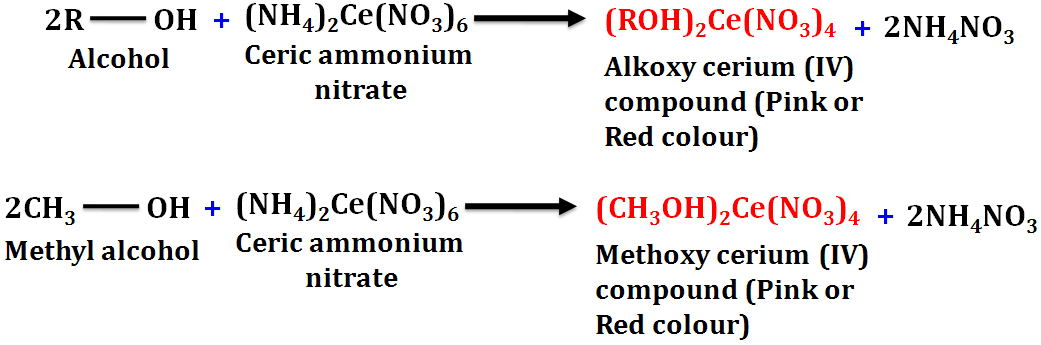
http://amrita.olabs.edu.in/?sub=73&brch=8&sim=141&cnt=1

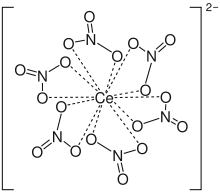
Physical properties
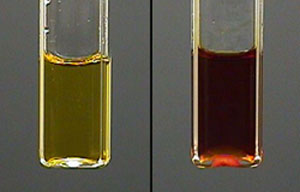
Complications
Hot solutions of Ce(IV) oxidize many organic compounds
http://884131013.blogfa.com/post/9
The Chromic Acid Test
Chemical properties
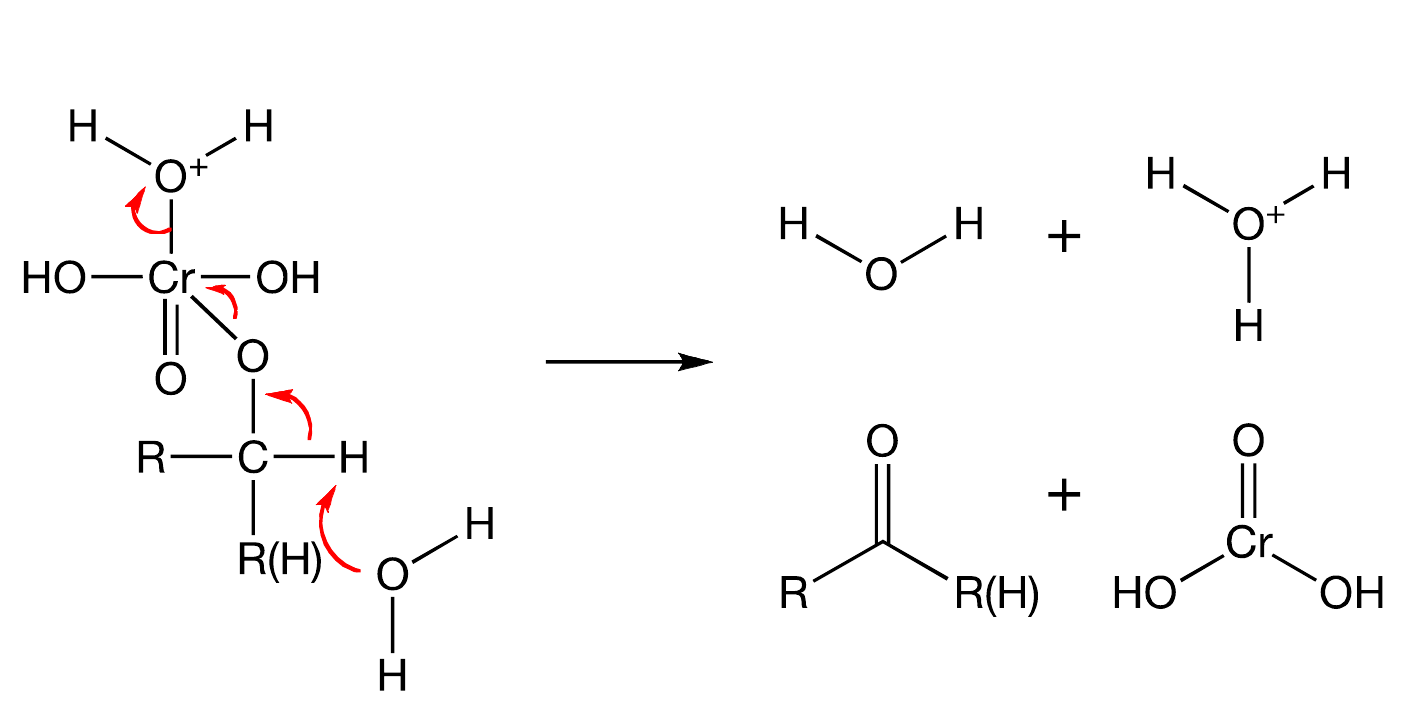
Mechanism of the Jones Oxidation
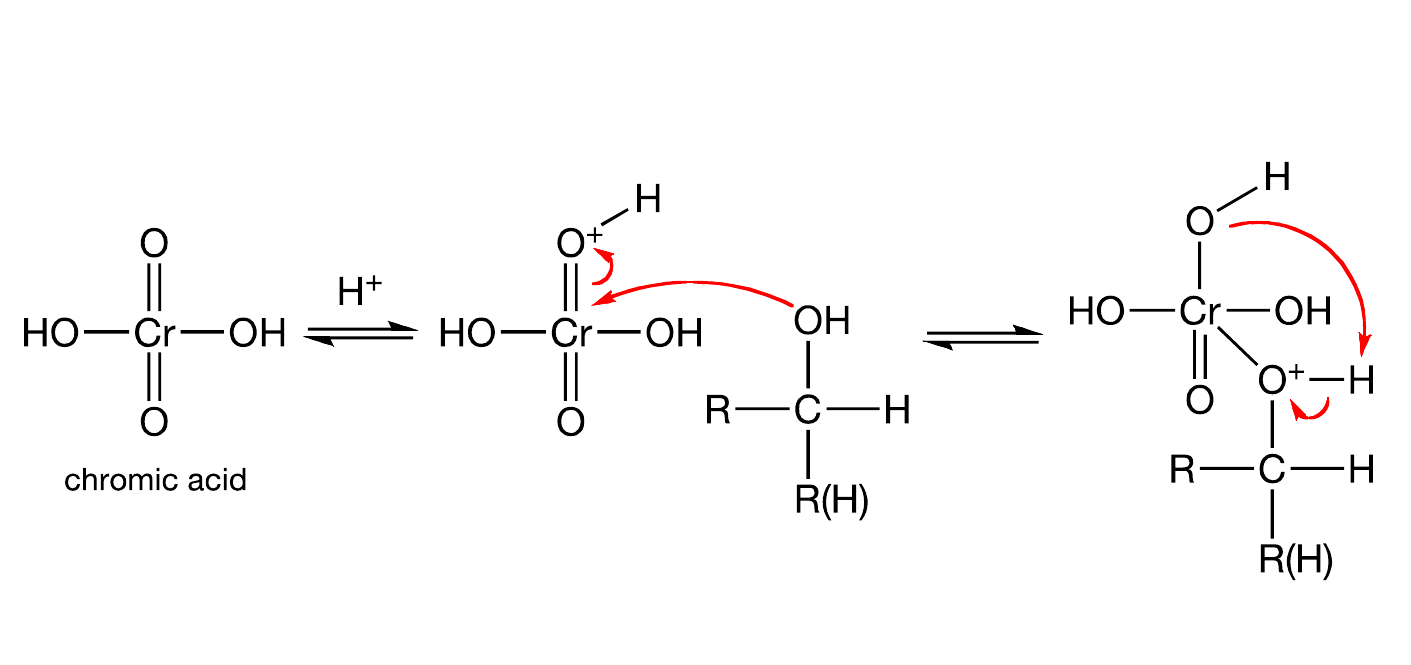
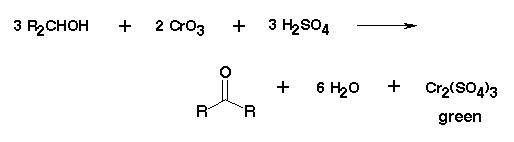
The is a mixture of chromic trioxide or sodium dichromate in diluted sulfuric acid, which forms chromic acid in situ

The alcohol and chromic acid form a chromate ester that either reacts intramolecularly or intermolecularly in the presence of a base (water) to yield the corresponding carbonyl compound

http://www.organic-chemistry.org/namedreactions/jones-oxidation.shtm
Shows positive test for
1o and 2o alcohols and aldehydes
Reactions:
aldehydes and primary alcohols are oxidized to carboxylic acids while the Cr+6 ion in the chromic acid is reduced to Cr+3.

secondary alcohols are oxidized to ketones while the Cr+6 ion in the chromic acid is reduced to Cr+3.

Physical properties

Complications
- Enols may give a positive test
- Phenols give a dark colored solution which is not blue-green like a positive test
http://academics.wellesley.edu/Chemistry/chem211lab/Orgo_Lab_Manual/Appendix/ClassificationTests/alcohol.html
The Lucas Test
Chemical properties
The Lucas test tells whether an alcohol is primary, secondary or tertiary. Tests like this were once regularly used to determine the structure of molecules. But modern structure elucidation methods like NMR have made such tests obsolete. What is the Lucas test? It’s just the SN1 reaction of an alcohol with HCl. The Lucas reagent is ZnCl2 in concentrated HCl.
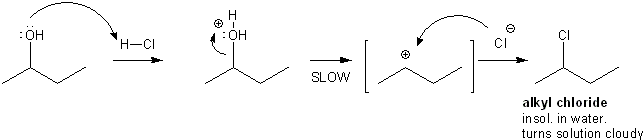
SN1 reaction of an alcohol with HCl
Recall that in SN1 reactions, a carbocation is formed. So alcohols that form stable carbocations will react faster than alcohols that form less stable carbocations. The product of this reaction is an alkyl chloride, which is insoluble in water; it’s formation will turn the solution cloudy. The rate with which a solution turns cloudy tells you whether the alcohol was 1º, 2 º, or 3. Tertiary alcohols will react and turn cloudy right away. Secondary alcohols will take a few minutes to react, and primary alcohols will won’t react at all.

3° carbocations are more stable than 2° or 1° carbocations and so form faster.
Based on this theory, you can expect the 2-methyl-2-propanol (also know as tert-butanol) to react faster than 2-butanol (also known as sec-butanol). 1-Butanol won’t react at all.
You might be wondering how the zinc gets involved in this reaction. Zinc is a Lewis acid, and so can accept a lone pair on an oxygen atom, resulting in a positively charged oxygen, which then acts a leaving group, leaving behind a carbocation. This is similar to what happens when oxygen picks up a proton, but happens even faster when zinc is present. So zinc speeds up the formation of the carbocation, which increases the rate of reaction. The Lucas test will go faster with ZnCl2 than in its absence.
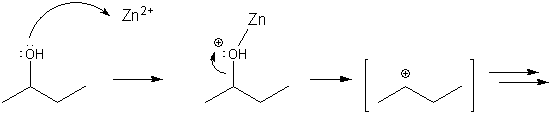
Zinc is a Lewis acid, and so speeds up the formation of the carbocation.
http://www.mendelset.com/articles/693/properties_alcohols
A mixture of anhydrous ZnCl2 + conc. HCl is called as Lucas reagent.
|
Primary |
ppt. appears after heating |
|
Secondary |
ppt. appears with in 5 minutes |
|
Tertiary |
ppt. appears immediately |



Physical properties

Complications
The test applies only to those alcohols soluble in the reagent (monofunctional alcohols lower than hexyl and some polyfunctional alcohols.) This often means that alcohols with more than six carbon atoms caot be tested.
برچسب:
نویسنده: کاوه زمانی